




13 Nov
Tuberous breast mastopexy: when it is necessary and what the operation involves
Many women have tuberous breasts to a certain degree.If you have been diagnosed with it or think it might be the case for you, you may need a mastopexy…or not. Let me explain.when it is indicated and how the operation is performed. Also, if it can be done withPreserved,A minimally invasive technique that is booming for breast augmentations and lifts.
When is a mastopexy necessary for tuberous breasts?
Quick answer: when there is ptosis.
But let me explain. A tuberous breast is a congenital anomaly that can involve various alterations. Each patient may present with one, several or all of them. And unilaterally (in one breast) or bilaterally (in both).
The most common are:
-
- Areolar herniation. This is what gives the breast its tubular shape.
- Unusually large areola, with an excessive diameter (macrotelia).
- High inframammary fold. The fold where the breast meets the chest wall sits higher than usual.
- Sagging (ptosis). The nipple-areola complex is level with (grade I, mild) or below the inframammary fold (grade II, moderate, or grade III, severe).
- Narrow breast base. The breast is not very wide, as if it were “constricted”.
- Small or flat lower pole due to a lack of glandular tissue development.
- Visible asymmetry in size and/or shape. Sometimes very pronounced.
With that said.
A mastopexy is needed if there is sagging, as part of the overall solution. Within corrective surgery for tuberous breasts, it allows us to lift the nipple-areola complex and reposition the breast to give it a firmer, more youthful and attractive appearance.
It may be indicated in one breast or in both. Ptosis does not necessarily occur symmetrically in both breasts. In fact, in our own experience, it is not uncommon for patients to require correction on only one side and not the other.
And it is usually periareolar or inverted-T. In mild cases, a periareolar mastopexy is usually enough. That is, through an incision around the areola. The resulting scar is very well concealed by the natural edge of the areola.
An implant may or may not also be needed. It depends on the patient’s anatomy, the amount of breast tissue and the aesthetic result she wants.
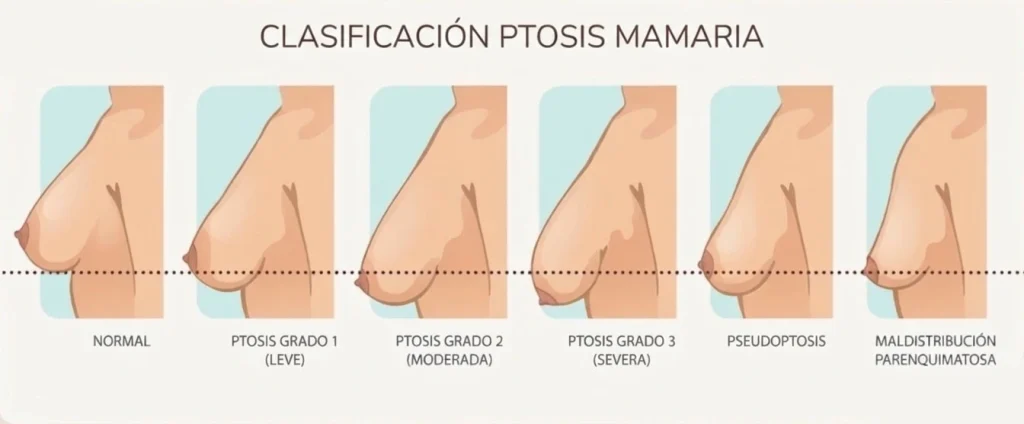
Breast ptosis classification. The line marks the height of the inframammary fold. In tuberous breasts there is a maldistribution of parenchymal tissue that may (or may not) be associated with a degree of ptosis ranging from mild to severe. Image generated with AI
What is a mastopexy operation for tuberous breasts like?
It is not a conventional surgery
A tuberous breast with ptosis is not corrected with a standard mastopexy.
It turns out that this is not a “normal” breast (in a physiological sense) that is simply due to aging, pregnancy, weight loss… it is sagging or empty. As I mentioned before, we are dealing with a congenital anomaly.
There are several theories about how it originates. In general, it has been observed that at the base of the breast is formed a ring of fibrous tissue that constricts the gland and limits its expansion. It forces it to grow forward through the areola (areolar herniation).
Imagine as if you will squeeze a balloon with the hand and it will deform.
In this way, the breast develops in that tubular shape. If it grows pointing downwards, the areola-nipple complex extends beyond the inframammary fold, resulting in ptosis.
Okay, so what does this mean?
That we’re going to need repairing the architecture of the chest in addition to lifting it as well as solving any existing problems. In other words, the mastopexy is only one part of what may be required to correct a tuberous breast.
That’s why I’m telling you it’s not like a conventional lift. A patient who does not have a tuberosity does not need this level of reconstruction.
The 5 most used techniques
Continuing with the above…
What procedures are combined with a mastopexy for tuberous breasts?
It is a fully personalized surgery.
On the one hand, it varies depending on what needs to be corrected. We use the Von Heimburg classification to assess it, which distinguishes 4 types of tuberous breast. The higher the type, the more severe the deformity and the more complex the surgery.
On the other hand, we take into account preferences and anatomical possibilities. Each patient has her own wishes regarding shape and size. We adapt as far as possible, always seeking to improve or restore symmetry.
Broadly speaking, what is most often done is:
-
- Release the constriction. The ring of fibrous tissue is “broken” to free the gland, widen the breast base and lower the inframammary fold. These are very precise incisions that prevent the tendency to return to the previous situation.
- Remodel the gland. Once released, it is redistributed throughout the breast to give it a rounded, aesthetic and natural appearance.
- Reduce and reposition the areola. Its size, herniation and position are corrected. This is where we perform the mastopexy to resolve the sagging and place the nipple-areola complex at an appropriate height and distance from the inframammary fold.
- Add volume with implants. Round, anatomical or ergonomic, depending on the case. They are usually placed in a dual-plane or subglandular position. At our clinic, we always try to use the inframammary approach. It’s safer.
- Lipofilling. We extract fat from another part of the body and use it to enhance breast fullness and refine its shape.
Different techniques are used depending on what is needed. And these aren’t the only ones. For example, large tuberous breasts sometimes need a reduction.
The surgery is performed under general anaesthesia and may or may not require an overnight hospital stay. If it is not very complex, at Cànons Clinics we perform it in our outpatient operating room.
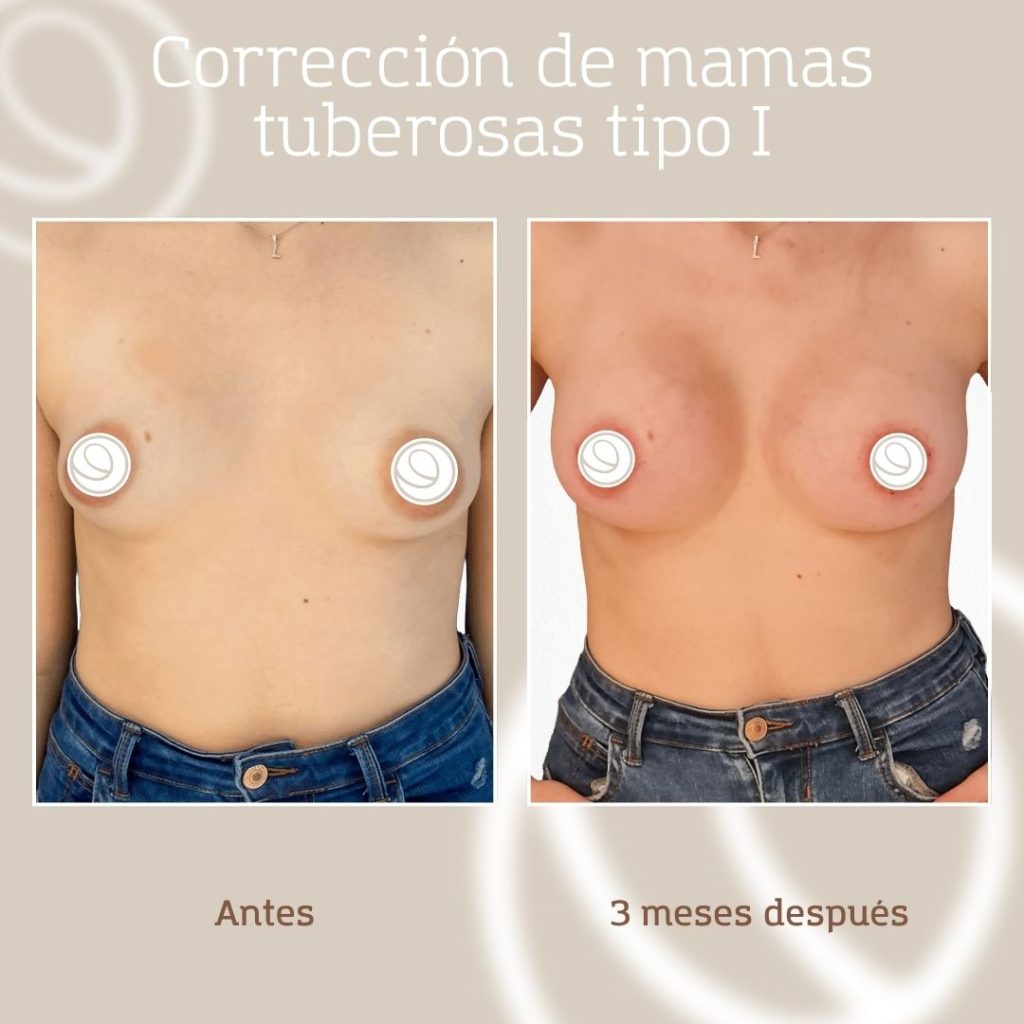
Young patient with type I tuberous breasts. In this case, a mastopexy was not necessary, as there was no ptosis.
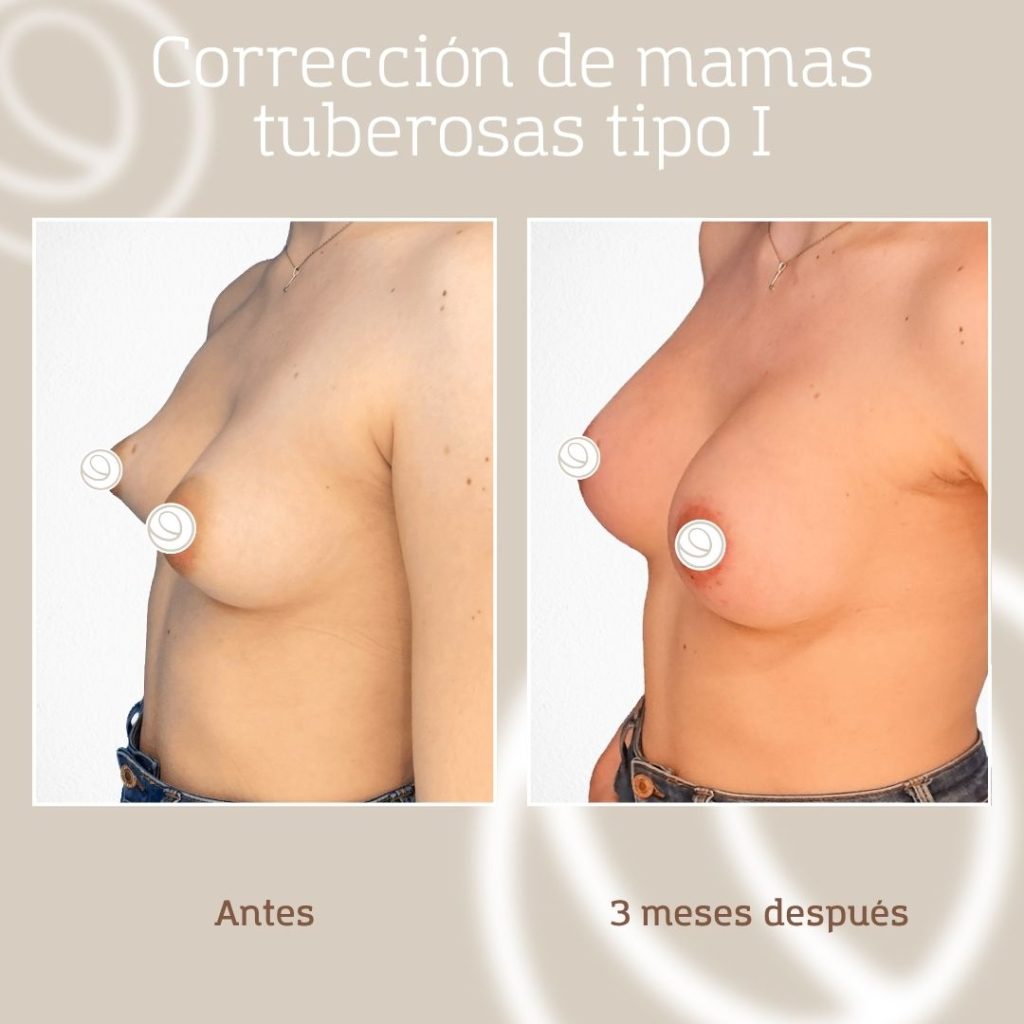
We put Motiva prosthesis ergonomic(325 cc (high profile) via submammary incision and corrected the areola with a periareolar incision. No scars are visible.
Results, postoperative period and complications
I’ll take it one step at a time.
The results of this surgery are very satisfactory. Tuberous breasts have a significant psychological and social impact. When you see your breasts round, firm and harmonious, with a proportionate areola, the feeling is indescribable.
In more severe cases, it is true that there is a greater chance of some residual asymmetry remaining or of breastfeeding being affected.
Even so, the improvement is so significant that patients end up happy.
Furthermore, the post-operative period is not very complicated. It depends on how complex the procedure has been. Treating a type I tuberous breast without implants or mastopexy is not the same as treating a type IV, which requires lifting and inserting implants.
Regarding complications:
-
- Most are associated with implants or poor surgical technique. Capsular contracture, malposition, rupture, seroma, infection, loss of sensation, poor healing…
- A well-known one is the double bubble sign. If the ring of fibrous tissue is not properly corrected, it can prevent the skin from stretching when the implant is inserted. This results in what looks like a double fold at the lower pole of the breast.
- There may also be rippling. That is, visible ripples in the skin. This is a consequence of using an implant that is too large in a tuberous breast that does not have enough tissue to cover it properly, of poor-quality skin, or of using insufficiently cohesive implants.
- These risks are minimal with a qualified plastic surgeon. It is a safe and effective surgery, but it requires an accurate diagnosis, highly refined medical skill and experience. You can’t put yourself in just anyone’s hands.
Is the Preservé technique used in mastopexies for tuberous breasts?
You may have heard of this procedure.
Preservé is a new minimally invasive breast augmentation technique used in some mastopexies with implants. Its main advantage is that it preserves more breast tissue than traditional surgery. Recovery is much faster.
It’s very popular right now. That’s why some patients with tuberous breasts may have seen it on social media and ask me in my office if they would be good candidates.
The answer most of the time is no.
Perhaps in very mild cases of tuberosity, although that’s not a good indication. Much less so in more complex cases where a more extensive reconstruction of the gland is required, or if the prosthesis must be placed in a submuscular plane.
But why don’t you come to the clinic and we’ll study your situation? Type of tuberous breast, degree of ptosis, whether we put implants or not… Every patient is different.
Canons Clinics is in Barcelona and Granollers. Make an appointment by calling 683 27 07 09 or write to us on WhatsApp at that same number or fill out our contact form.
We’ll be happy to help you.
Literature
If you’d like to investigate further…
-
- Lozito A et al. Review of Tuberous Breast Deformity: Developments over the Last 20 Years. Plast Reconstr Surg Glob Open. 2022;10(5):e4355. Source.
- von Heimburg D et al.The tuberous breast deformity: classification and treatment. Br J Plast Surg. 1996 Sep;49(6):339-45. Source.
- Grella R, D’Andrea F, Nicoletti GF, Lanzano G.Tuberous Breast Management: A Review of Literature and Novel Technique Refinements. Plast Reconstr Surg Glob Open. 2022 Dec 15;10(12):e4708. Source.
- van Durme J et al.The Different Surgical Strategies for Treating Tuberous Breast Deformity: A Scoping Review. JPRAS Open. 2024;42:315-328. Source.
- Brown MH, Somogyi RB.Surgical Strategies in the Correction of the Tuberous Breast. Clin Plast Surg. 2015 Oct;42(4):531-49. Source.
- Toomey AE, Cape JD. Mastopexy (Breast Lift) [Internet]. StatPearls. Treasure Island (FL): StatPearls Publishing; 2024 [accessed 29 oct 2026]. Source.
- Alvaro AI et al. A Systematic Review of Outcomes and Complications of Tuberous Breast Surgery. Aesthet Surg J. 2023 Nov 16;43(12):NP1001-NP1009. Source.

Dr. Víctor Hernàndez Machado.
Medical Director of Cànons Clinics
Plastic surgeon specializing in facial surgery and body contouring, with experience in the private sector since 2001. I advocate for honest aesthetic surgery and medicine in which results improve, not change. Registered doctor in Barcelona number 30493, member of the SECPRE and general secretary of the Spanish Society of Surgical Medical Lasers (SELMQ).
Currículum. LinkedIn.
Sorry, the comment form is closed at this time.