




27 May
Current treatments for gynecomastia: can it be corrected without surgery?
Gynecomastia is very common in men. More so than people realize or talk about. It’s not a coincidence that surgical correction is the second most common procedure in plastic surgery, after blepharoplasty that is number one. But is it the only solution today, or are there other effective treatments? Let’s take a look.
Non-surgical treatments to reduce gynecomastia
True gynecomastia VS pseudogynecomastia
First, we need to make a distinction.
Patients often come to CànonsClinics thinking they have gynecomastia when it’s actually a pseudogynecomastia. They may look similar on the outside, but internally they are different processes that can even occur simultaneously.
This determines the treatment options.
In true gynecomastia the size of one or both of the man’s breasts increases abnormally (unilateral or bilateral) because the mammary glandular tissue proliferates.
This is mainly due to an imbalance between testosterone and estrogens. Breast growth can be caused by natural physiological changes, medications, toxins, pathologies, or unknown factors. Estrogens predominate, inducing this breast growth.
There are 4 ways to approach it:
-
- Pharmacological therapy.
- Discontinue the causative medication or drug.
- Waiting and observing in adolescents.
- Surgery.
Now I will explain each point to you.
In the pseudogynecomastia or lipomastia, this increased breast volume is due to a fat accumulation, adipose tissue, not glandular. It is common in obesity or overweight patients . Therefore, weight loss and adopting a healthy lifestyle will be key here.
Pharmacological therapy
In some men, gynecomastia can be treated with:
-
- Medication for underlying conditions that are causing it. Hyper- or hypothyroidism, chronic kidney failure, hypogonadism… Various diseases can cause this physical change.
- Hormonal medications. They aim to restore the balance between testosterone and estrogen to reverse excess breast tissue and alleviate associated symptoms. Scientific evidence is limited.
Two points of clarification.
The first is that there are no miracle cures. Many patients ask primarily about hormonal medications in the hope of avoiding surgery.
The problem, besides the potential adverse reactions, is that they are only effective in certain cases and don’t always completely correct gynecomastia. In fact, if it has been present for more than two years, they are usually useless.
The second thing is that a physician must confirm this for you. If you are a candidate to receive any of these drugs. Don’t draw conclusions withChatGPT or other generative AI (if you use them for these purposes).
Discontinue the causative medication or drug
Are you taking any medication?
You’d be surprised to know how many medications can cause gynecomastia as a side effect. For example, some of those prescribed to treat androgenetic alopecia.
If there is suspicion that a pharmacological treatment, this could be causing the breast enlargement; it should be assessed whether replace it or suspend it. With this alone, there are already cases where the breast decreases and returns to a masculine appearance after a while.
Ask your family doctor or specialist.
There are also recreational drugs that can cause or aggravate this condition.Alcohol, marijuana, heroin, amphetamines…Alcohol, for example, stimulates aromatase, an enzyme that transforms testosterone into estradiol (an estrogen).
Logically they are toxic substances that must be abandoned. For this reason and for the other harmful effects they may cause to health.
Be careful with the anabolic steroids for sports use or supplemenations.Among many other adverse reactions, in men they can induce breast growth.
Waiting and observing in adolescents
Many teenagers suffer from gynecomastia..
Parents arrive at the clinic very worried, seeking an immediate solution for their child. The situation is affecting them personally and socially: shame, insecurity, low self-esteem, anxiety, problems at school, bullying, and so on.
If it’s already difficult for an adult…
It seems illogical, but in situations like this, it’s best to be cautious. Why? Because in up to 90% of cases, pubertal gynecomastia resolves on its own alone in 1-2 years. So the most reasonable thing to do is wait and monitor during that period.
Meanwhile, if necessary, psychological support should be available.
When would we consider medical or surgical treatment?
-
- If the chest does not regain its masculine shape within that time.
- If the breast volume is excessive or grows very quickly.
- If it hurts a lot or there are certain symptoms and signs.
- If it is affecting you too much on a psychosocial level.
- When it is unilateral.
In adults, this strategy does rarely work. In adolescents, yes, because the hormonal upheaval typical of this stage often leads to an increase in breast glandular tissue. That’s why, just as quickly as it appears, it often disappears.
But from age 20-30 onwards, other causes predominate and other approaches are required.
Weight loss
Weight loss is the basic treatment for pseudogynecomastia.
Here, it’s an excess of adipose tissue that alters breast size. Therefore, the goal is to reduce fat deposits. And to achieve this, the most important thing is to improve your lifestyle.Good nutrition, exercise, etc.
According to the patient, liposuction could be considered.
By the way, if you have true gynecomastia, getting in shape won’t reduce it.Don’t obsess over following a strict diet plan or pushing yourself to the limit at the gym, because glandular tissue doesn’t disappear that way. On the contrary, it can become more prominent.
Surgical treatments to remove gynecomastia
The 3 techniques that are used
All of the above are conservative, non-invasive measures.
Surgery to correct gynecomasti is often the only effective treatment, especially if the condition has persisted for more than 1-2 years without improvement, if drug therapy has failed, or if withdrawing the causative medication or drug does not imoprove.
It is an operation that achieves a male chest, flat and stylized. It’s very satisfying. And with permanent results provided there are no new diseases, medications or toxins that cause the breast to grow again.
We perform it frequently at our clinic.
In summary, there are 3 techniques:
-
- Mastectomy. to remove excess glandular tissue, reduce breast volume, and restore a masculine appearance.
- Laser Assisted Liposuction, to eliminate fat deposits, further define the pectoral contour and improve aesthetics.
- Skin resection. To remove excess skin and make the breast appear firmer. It is especially common when a large amount of glandular tissue has been removed.
All three procedures are not necessary. It depends on what is excess tissue (glandular tissue, fat, and/or skin).They combine in one way or another and it is evaluated during the diagnostic consultation.
Anyway, it’s a very safe intervention. The risks are minimal in the hands of a qualified plastic surgeon.
Furthermore,it is usually performed on an outpatient basis.Complex patients may require hospital admission, but most go home the same day.
And it has a good recovery. Relative rest and avoidance of sports, follow specific care guidelines, gradually return to routine activities, and wear a compression garment (like a vest). The timeframe depends on the severity of the case.
The final result is visible at 6 months.
The scar is usually almost invisible.Most commonly, ion semicircular shape that remains at the lower edge of the areola, blending in with the areola itself.
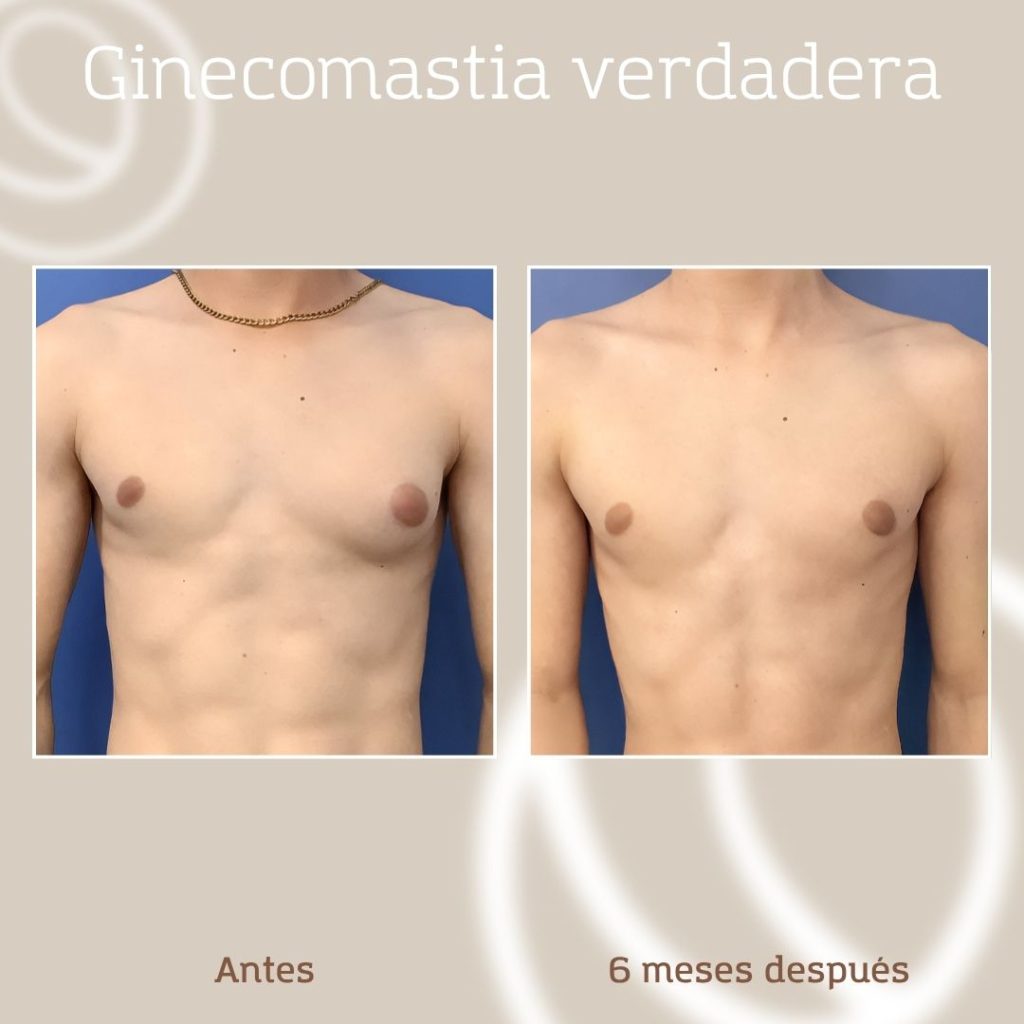
Unilateral true gynecomastia solved only with a mastectomy. The scars are imperceptible to the naked eye and do not betray the operation.
What we recommend at our clinic
At Cànons Clinics we treat many patients with gynecomastia.
The corrective surgeries we perform most often are:
-
- Mastectomy only.
- Mastectomy + liposuction + skin resection.
- Liposuction alone for pseudogynecomastia.
We only use general anesthesia for bilateral gynecomastia. If it’s unilateral (affecting only one breast), local anesthesia with sedation is sufficient.
Our unique feature is that we do laser-assisted liposuction(Lipolaser) if fat tissue needs to be removed. Compared to traditional liposuction recovery is faster, with fewer complications, and the chest becomes more defined. With smoother skin.
On the other hand, we applied UrgoTouch laser to improve the appearance of the scar. It results in a thinner, smoother, and more discreet appearance. We use it in all procedures except when performing laser liposuction alone. It leaves such tiny marks that no treatment is necessary.
Surgical treatments to remove gynecomastia
The 3 techniques that are used
All of the above are conservative, non-invasive measures.
Surgery to correct gynecomasti is often the only effective treatment, especially if the condition has persisted for more than 1-2 years without improvement, if drug therapy has failed, or if withdrawing the causative medication or drug does not imoprove.
It is an operation that achieves a male chest, flat and stylized. It’s very satisfying. And with permanent results provided there are no new diseases, medications or toxins that cause the breast to grow again.
We perform it frequently at our clinic.
In summary, there are 3 techniques:
-
- Mastectomy. to remove excess glandular tissue, reduce breast volume, and restore a masculine appearance.
- Laser Assisted Liposuction, to eliminate fat deposits, further define the pectoral contour and improve aesthetics.
- Skin resection. To remove excess skin and make the breast appear firmer. It is especially common when a large amount of glandular tissue has been removed.
All three procedures are not necessary. It depends on what is excess tissue (glandular tissue, fat, and/or skin).They combine in one way or another and it is evaluated during the diagnostic consultation.
Anyway, it’s a very safe intervention. The risks are minimal in the hands of a qualified plastic surgeon.
Furthermore,it is usually performed on an outpatient basis.Complex patients may require hospital admission, but most go home the same day.
And it has a good recovery. Relative rest and avoidance of sports, follow specific care guidelines, gradually return to routine activities, and wear a compression garment (like a vest). The timeframe depends on the severity of the case.
The final result is visible at 6 months.
The scar is usually almost invisible.Most commonly, ion semicircular shape that remains at the lower edge of the areola, blending in with the areola itself.
Unilateral true gynecomastia solved only with a mastectomy. The scars are imperceptible to the naked eye and do not betray the operation.
What we recommend at our clinic
At Cànons Clinics we treat many patients with gynecomastia.
The corrective surgeries we perform most often are:
-
- Mastectomy only.
- Mastectomy + liposuction + skin resection.
- Liposuction alone for pseudogynecomastia.
We only use general anesthesia for bilateral gynecomastia. If it’s unilateral (affecting only one breast), local anesthesia with sedation is sufficient.
Our unique feature is that we do laser-assisted liposuction(Lipolaser) if fat tissue needs to be removed. Compared to traditional liposuction recovery is faster, with fewer complications, and the chest becomes more defined. With smoother skin.
On the other hand, we applied UrgoTouch laser to improve the appearance of the scar. It results in a thinner, smoother, and more discreet appearance. We use it in all procedures except when performing laser liposuction alone. It leaves such tiny marks that no treatment is necessary.
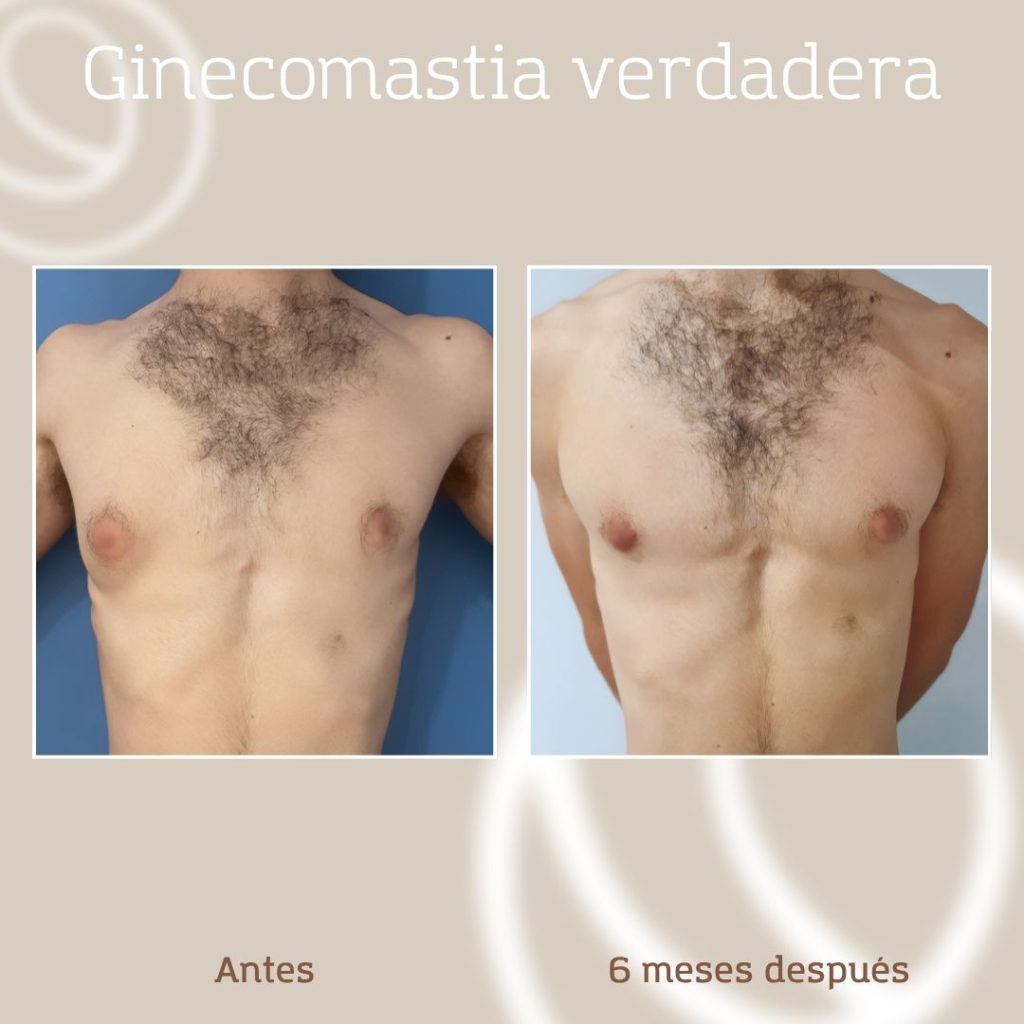
After undergoing a mastectomy, the patient’s affected breast has regained its masculine contour and the bulging appearance is no longer noticeable.
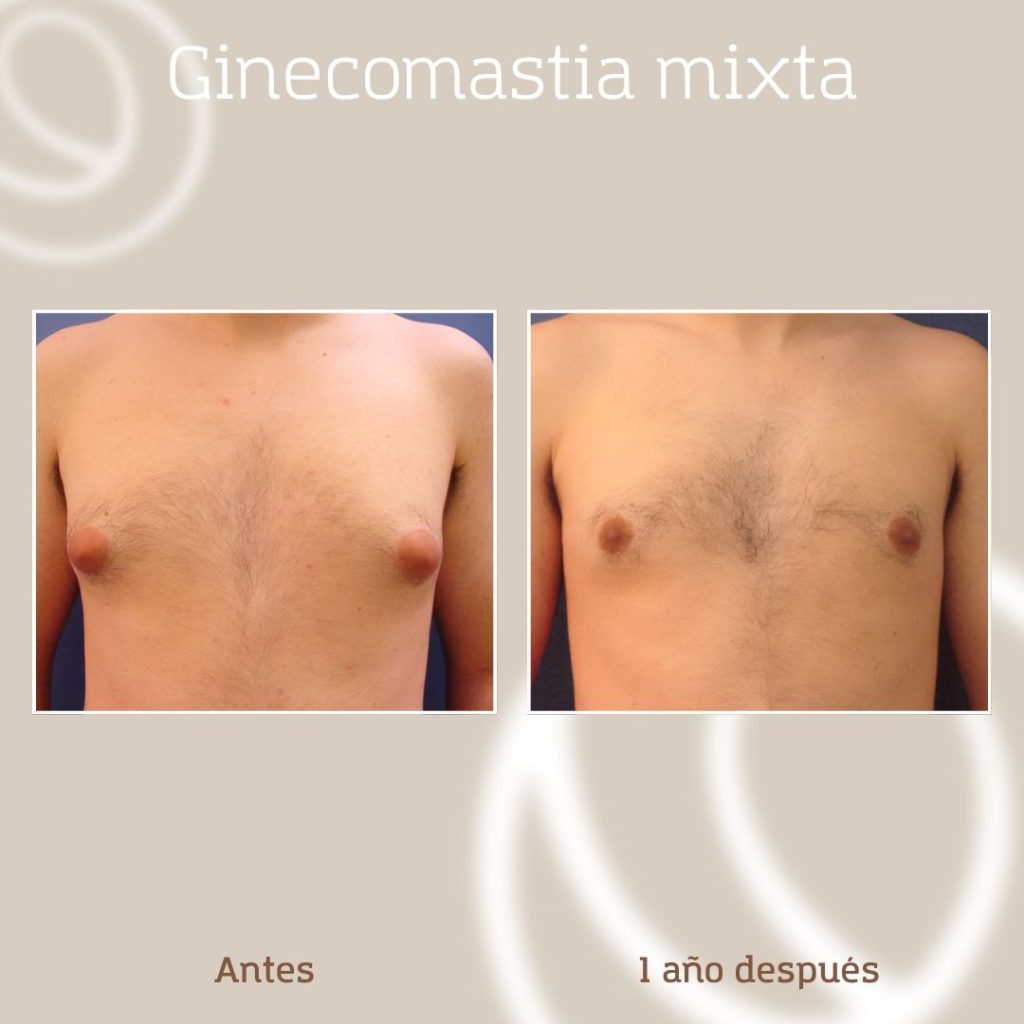
The patient had very little glandular tissue, so we only performed laser liposuction, which reduced the areolar diameter. He was very happy with the result.
Would you need surgery to remove your gynecomastia?
It depends.
If it is true gynecomastia of less than 2 years and you are a teenager it is very likely that it will reverse on its own without the need for surgical treatment.
If it has lasted longer than that, it affects you a lot or the drug therapy has failed, surgery is the only definitive solution. If it’s very mild, you might see some improvement with diet and exercise… But in the vast majority of cases, surgery will be necessary.
If the cause is an underlying disease, there are cases where simply treating the condition could help restore the breast’s shape (though not always). The same applies if the condition is caused by medication and is discontinued under medical supervision, or by a drug and its use is stopped.
If it is pseudogynecomastia, losing weight and adopting healthy lifestyle might seem sufficient at first glance. However, some patients still aren’t completely satisfied with their results. In those cases, liposuction may be the right choice.
I maintain that it depends.
Therefore, the first thing to do is a good medical diagnosis that includes an ultrasound stud. and anthropometric meassurements.
In Canons Clinics we assess:
-
- Complete medical history, family background and habits.
- Type, grade and cause of gynecomastia. True, pseudo or mixed, unilateral or bilateral, amount of gland/fat, asymmetry, breast sagging, skin quality.
- Associated discomforts. Pain, inflammation, tenderness, psychological impact.
- Other symptoms or signs (e.g., testicular discomfort) that may be warning us that there is a more serious underlying pathology.
This helps us determine the need to operate and adjust expectations.
Tell me your story and clear up your doubts
Do you think you might require surgery to correct your gynecomastia?
Nobody likes going under the knife, but medicine is advancing. It’s now a simple and very safe operation. And very satisfying. Because it takes away a burden that weighs you down every day. It gives you back comfort, confidence and quality of life.
Almost all patients end up thinking the same thing”…I wish I had made it before”.
If you’re considering this for yourself or your child, come to the clinic, tell me about your situation, and we’ll see if it would be the best option for you or if it would be preferable to try other treatments first. We’ll answer all your questions (procedure, results, price, etc.) with no obligation.
Canons Clinics centers are located in Barcelona and Granollers.Call us or send a WhatsApp message to 683 27 07 09 to book an appointmentOr fill out our contact form.
I’d be happy to help you.
Literature
If you’d like to investigate further…
-
- Barasoain A. Ginecomastia. An Pediatr Contin. 2012;10(4):183-91. Source.
- Fagerlund A et al. Gynecomastia: A systematic review. J Plast Surg Hand Surg. 2015;49(6):311-8. Source.
- Sociedad Española de Cirugía Plástica Reparadora y Estética. Cirugía de mama. Ginecomastia [Internet]. SECPRE [accessed 15 May 2026]. Source.
- Kanakis GA et al. EAA clinical practice guidelines-gynecomastia evaluation and management. Andrology. 2019;7(6):778-793. Source.
- Berger O, Landau Z, Talisman R. Gynecomastia: A systematic review of pharmacological treatments. Front Pediatr. 2022;10:978311. Source.
- Trinchieri A et al. Drug-induced gynecomastia: A systematic review and meta-analysis of randomized clinical trials. Arch Ital Urol Androl. 2021;93(4):489-496. Source.
- Waltho D, Hatchell A, Thoma A. Gynecomastia Classification for Surgical Management: A Systematic Review and Novel Classification System. Plast Reconstr Surg. 2017;139(3):638e-648e. Source.
- Sociedad Española de Cirugía Plástica Reparadora y Estética. La realidad de la cirugía estética en España [Internet]. SECPRE; 2022 [accessed 15 May 2026]. Source.

Dr. Víctor Hernàndez Machado.
Medical Director of Cànons Clinics
CPlastic surgeon specializing in facial surgery and body contouring, with experience in the private sector since 2001. I advocate for honest aesthetic surgery and medicine in which results improve, not change. Registered doctor in Barcelona number 30493, member of the SECPRE and general secretary of the Spanish Society of Surgical Medical Lasers (SELMQ).
Currículum. LinkedIn.
Sorry, the comment form is closed at this time.